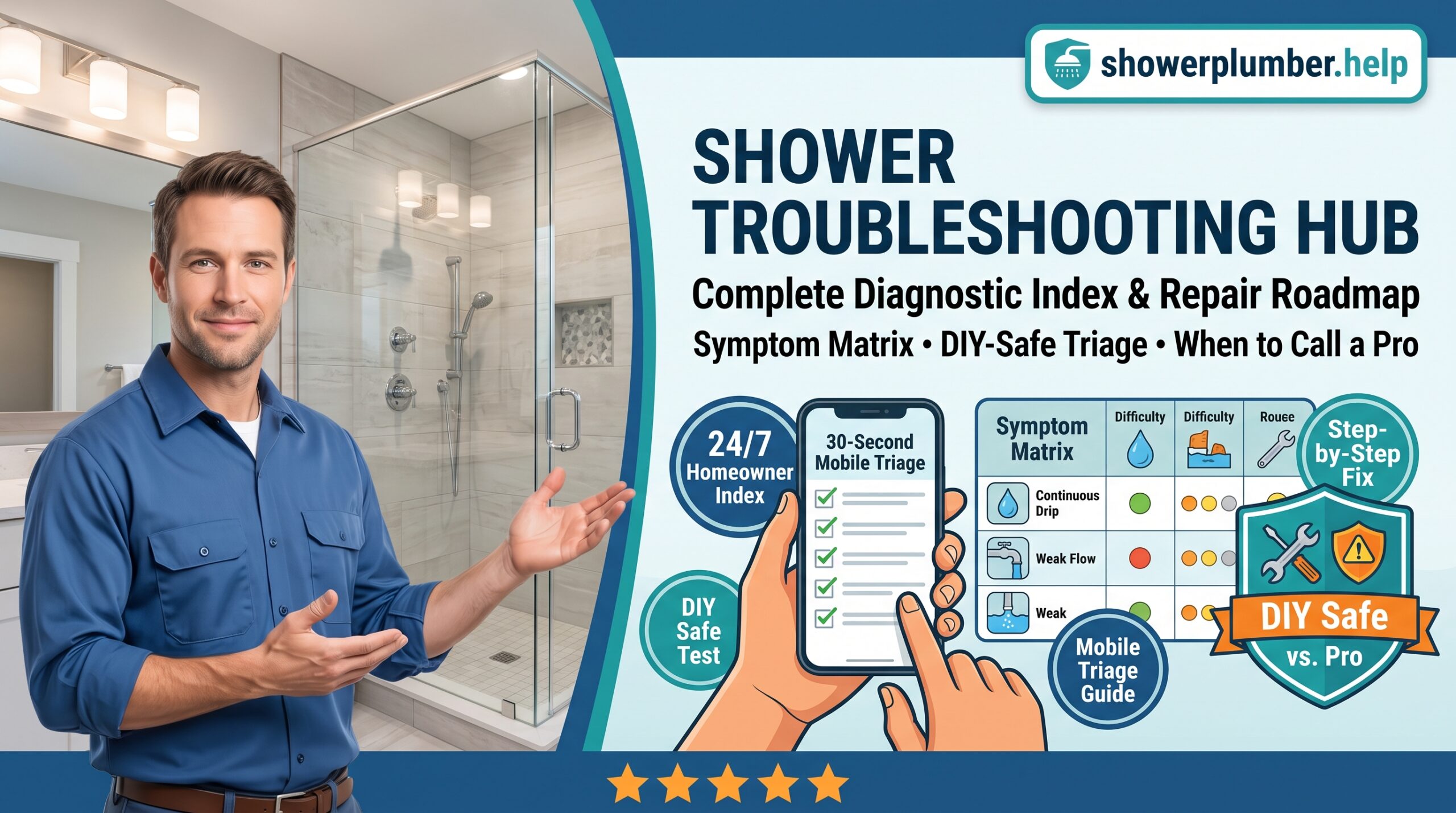
Diagnosing a broken shower shouldn’t require guessing games or unhelpful trade jargon. Whether you’re dealing with an unrelenting drip at midnight, scalding temperature surges, water trickling from your tub spout, or mysterious dampness on the ceiling below, this central hub gives you an immediate, systematic triage sequence.
Select your symptom below to isolate the failing component, review safe DIY fixes, and know the exact threshold where calling a licensed plumbing professional is necessary to protect your home from water damage.
📱 30-Second Mobile Diagnostic Triage
Run this quick 3-step test on your phone right next to your shower to instantly narrow down the culprit:
- Is the leak constant or only when running? If it drips 24/7 with the handle off, the cartridge O-rings/seats have failed. If it only drips while showering, check the shower arm threads or riser pipe.
- Is pressure low on both hot and cold? If both sides are weak, clean the showerhead nozzles and flow restrictor. If only hot water is weak, the cartridge balancing spool or water heater is restricted.
- Does water pool outside the enclosure? Check the bottom glass door sweep or perimeter caulk. If water stains the ceiling below, conduct a shower pan flood test.
Quick Symptom & Diagnostic Directory
Tap any common shower issue below to reveal the root cause, immediate DIY fix, and full deep-dive repair guide:
1. Dripping Showerhead (Handle Turned Completely Off)
The Root Cause: Degraded rubber O-rings, flattened valve seats, or mineral scoring along the internal cartridge cylinder body (Moen 1222/1225, Delta RP46073, or Kohler Rite-Temp).
The Fix: Shut off the main water line, pull the retaining clip or bonnet nut, remove the old cartridge, lubricate the new unit with silicone plumber’s grease, and reinsert.
2. Sudden Temperature Swings (Scalding or Freezing Surges)
The Root Cause: A calcified or stuck pressure-balancing spool. When a toilet flushes or a washing machine runs, the spool fails to shift laterally to balance incoming water pressure.
The Fix: Remove the cartridge and soak it in warm white vinegar to dissolve calcium, or install a replacement cartridge equipped with a free-moving pressure spool.
3. Weak, Limp, or Sputtering Water Pressure
The Root Cause: Clogged silicone spray jets, debris trapped in the mesh inlet screen, or a restricted whole-house Pressure Reducing Valve (PRV).
The Fix: Unscrew the showerhead, rinse the mesh filter screen, and soak the fixture in white vinegar for 2–4 hours. If pressure is low throughout the entire house, test static PSI at an outside hose bib.
4. Leaking Behind the Wall / Dripping Shower Arm
The Root Cause: Deteriorated Teflon tape at the threaded brass drop-ear elbow, or a cracked soldered copper riser pipe inside the stud cavity.
The Fix: Slide back the decorative escutcheon plate. If the leak is at the threads, unscrew the shower arm, clean the threads, wrap 4–5 turns of PTFE tape plus pipe dope, and reseat.
5. Water Escaping the Shower Pan / Wet Ceiling Below
The Root Cause: Failed compression drain gasket on acrylic pans, torn waterproofing membrane beneath custom tile, or brittle bottom glass door sweeps.
The Fix: Replace worn vinyl bottom wipes on glass doors. For ceiling leaks, perform an isolation flood test with a mechanical rubber test plug to verify whether the pan liner or drain pipe has failed.
6. Water Trickling from Tub Spout While Showerhead is On
The Root Cause: A worn-out diverter lift gate inside the tub spout, allowing water to bypass the diverter washer instead of being forced up the riser pipe.
The Fix: Clean mineral deposits around the diverter lift pin, replace the rubber gate washer, or unscrew the entire tub spout (slip-on set screw or threaded iron pipe) and install a replacement.
7. High-Pitched Whistling, Squealing, or Pipe Clanking
The Root Cause: Severe mineral restriction inside the cartridge intake ports, high municipal water pressure exceeding 80 PSI, or unclipped pipes vibrating inside the wall cavity (water hammer).
The Fix: Check whole-house PSI with a gauge. If excessive, adjust or replace your main water regulator; replace the scaled shower cartridge or install inline water hammer arrestors.
8. Electric Shower Running Cold / Motor Humming
The Root Cause: A tripped Thermal Cut-Out (TCO) switch caused by scale-choked spray heads, an air-locked internal booster pump, or a burned-out heating element.
The Fix: Descale the handset immediately to vent trapped heat. For air locks, lower the showerhead to the floor on cold flow to purge air. For breaker trips or internal casing leaks, contact a licensed professional immediately.
Responsive Troubleshooting Matrix (Quick Lookup)
Compare issues across symptom, severity, and trade difficulty at a glance:
| Issue | Primary Culprit | Difficulty | Action |
|---|---|---|---|
| Continuous Drip | Valve Cartridge / O-Rings | Beginner (DIY) | Swap Cartridge |
| Weak Flow | Clogged Showerhead / PRV | Beginner (DIY) | Vinegar Soak |
| Shower Arm Leak | Dried Teflon / Drop Ear | Beginner (DIY) | Reseal Threads |
| Ceiling Stains | Pan Liner / Drain Gasket | Advanced (Pro) | Flood Test / Hire Pro |
| Frozen Cartridge | Galvanic Mineral Bond | Intermediate (DIY) | Use Cartridge Puller |
| Breaker Tripping | Electric Shower Element | Pro Only | Hire Electrician |
⚠️ Crucial Safety Boundaries: When to Stop and Call a Pro
As an independent informational blog, showerplumber.help encourages smart DIY habits—which means knowing when to set tools down. Immediately shut off your main water valve and call a licensed plumber if:
- Water is actively dripping through subfloors, joists, or electrical light fixtures below.
- A seized brass cartridge refuses to budge and applying force begins flexing internal copper pipes.
- A brass drop-ear elbow or threaded nipple has broken off flush inside the wall fitting.
- The valve body requires torch soldering or pipe alteration within an enclosed wall cavity.
Explore All Detailed Pillar Guides
Ready to carry out a step-by-step repair? Jump straight into our authoritative technical walkthroughs: